
Why Should We Learn the English Language? Letters, Alphabet & Logic
Hello Students! Welcome back to EnglishEraWithAmitPoonia.
Often when students join our platform, they have a big question in mind—“Amit Sir, when our national identity and Hindi language are so rich, why do we need to learn the English Language?” Or some people think that learning English means underestimating their own mother tongue.
In today’s special digital class, we will understand the real logic behind this thought process. Along with that, we will start from the very basics of the English language—the English Alphabet—and clear up a confusion that 90% of learners get wrong. So, without any rote memorization, let’s start the class with pure logic!
Classroom Conversation: Hindi is Identity, English is Language Opportunity
Rohan: Sir, I feel scared of learning English. I feel like I am moving away from my mother tongue, Hindi.
Amit Sir: You have raised a very sensitive and excellent point, Rohan! Lock this logic in your mind forever: India is a country of diverse languages and cultures. Hindi is a major medium that connects people across different states. Hindi helps us communicate locally and fulfill our daily needs. We respect Hindi, we speak Hindi, and we must always preserve it.
Priya: But Sir, what happens when we think about traveling outside the country or working in a large global company?
Amit Sir: That is the exact point, Priya! There are hundreds of countries in the world, and every country has its own distinct language. It is impossible for us to learn the languages of all countries. Therefore, English has been chosen across the world as a common global language.
Amit Sir’s Mantra: Learning the English Language does not mean abandoning or disrespecting Hindi at all. While retaining full love and respect for Hindi, you can still learn English to communicate internationally and advance in your career. Put simply—Hindi is our identity, and English is our opportunity! Both can exist together without any conflict.
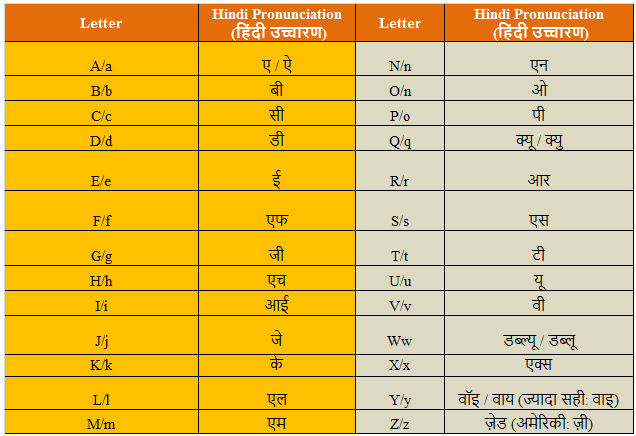
English Language Alphabet (A–Z): Letters, Pronunciation & Examples
Amit Sir: Now, let’s start learning English right from the basics. I have a quick question for all of you: “How many Alphabets are there in the English language?”
Rohan & Priya (together): Sir, that is so easy! There are 26 Alphabets in English.
Amit Sir: I knew you would give this exact answer! But my friends, this answer is completely incorrect. Let’s understand the real grammar logic behind it.
Alphabet: The entire set of letters in any language is called an ‘Alphabet‘. Therefore, the English language has only one (1) Alphabet.
Letters: The individual characters within that one alphabet (A, B, C…) are called ‘Letters’. There are 26 Letters in English.
So next time someone asks, say with confidence—“English doesn’t have 26 alphabets; it has only one alphabet which contains 26 letters!”
Classification of English Language Letters
These 26 letters can be written in two styles—Capital Letters (A, B, C…) and Small Letters (a, b, c…). Based on pronunciation and sound, they are categorized into two main groups:
| Group Type | Letters Included | Total Count | Logic & Function |
| Vowels | A, E, I, O, U | 5 | Vowels (Swar): It is almost impossible to pronounce or form a complete English word without these. |
| Consonants | B, C, D, F, G, H, J, K, L, M, N, P, Q, R, S, T, V, W, X, Y, Z | 21 | Consonants (Vyanjan): All the remaining letters apart from the vowels are called consonants. |
Types of Sentences in English Grammar: From Basic to Advanced Rules
Hello Students! Welcome back to EnglishEraWithAmitPoonia.
In our previous class, we learned what a sentence actually is. In today’s special digital lesson, we are moving on to the next and most crucial topic—Types of Sentences.
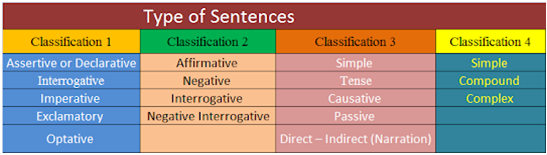
In the English language, sentences are classified into different categories based on their purpose, meaning, and sentence structure. Whether you are engaging in everyday conversation, asking a question, or expressing a complex idea, understanding the exact grammar logic behind these sentence types is essential for mastering the English language.
So, grab your notebook and pen, and let’s explore these 10 core sentence types with straightforward logic right inside our digital classroom!
💬 Classroom Conversation: Understanding the Varieties of Expressions
Rohan: Sir, I used to think there were only four sentence types, but our grammar book lists so many! Do we have to memorize all of them?
Amit Sir: Not at all, Rohan! Rote learning is strictly forbidden in our class. You only need to understand the underlying emotion and purpose behind each sentence. As soon as you read a statement, its core logic will become clear on its own. Let’s break them down one by one on the board.
1. Assertive or Declarative Sentences
The Logic: A sentence that expresses a general fact, opinion, or thought is called a sentence . Its primary purpose is to inform or state a fact in the English language.
Identification Rule: It always ends with a standard period (.).
Examples:
I am a student.
The sun rises in the east.
She likes ice cream.
2. Interrogative Sentences
The Logic: A sentence that asks a question is called an Interrogative Sentence. It is used whenever you want to ask something or seek information.
Identification Rule: It always ends with a question mark (?).
Examples:
What is your name?
Are you coming to school?
Where is my book?
3. Imperative Sentences
The Logic: When you give a command, instruction, request, or suggestion to someone, it is classified as an Imperative Sentence.
Examples:
Close the door. (Command/Order)
Please help me. (Request)
Don’t touch that! (Instruction/Warning)
4. Exclamatory Sentences
The Logic: Sentences that convey sudden, intense emotions, excitement, surprise, or strong feelings are called Exclamatory Sentences.
Identification Rule: It always ends with an exclamation mark (!).
Examples:
What a beautiful house!
Oh! I forgot my bag.
Hurray! We won the match.
5. Optative Sentences
The Logic: Sentences that express a wish, desire, hope, or prayer are known as Optative Sentences.
Identification Rule: These sentences frequently begin with “May” or “If only” and can end with either a period (.) or an exclamation mark (!).
Examples:
May you be happy!
If only I could fly!
May God bless you.
6. Causative Sentences
The Logic: This is an advanced and very practical sentence structure! Causative Sentences are used when the subject does not perform the action directly, but instead causes, arranges, or motivates someone else to perform it (e.g., “getting something washed” or “having something repaired”).
Examples:
She got her car washed. (She did not wash it herself; she arranged for someone else to do it.)
I am having my house painted.
7. Passive Voice Sentences
The Logic: A Passive Voice sentence is one where the subject receives the action of the verb. In these sentences, the emphasis shifts away from the doer of the action onto the action itself or the object receiving it.
Examples:
Active: Ram writes a letter.
Passive: A letter is written by Ram.
8. Simple Sentences
The Logic: Now let’s examine sentences based on structural formation. A Simple Sentence is a straightforward sentence structure in the English language that contains only one independent thought. It consists of just one subject and one finite verb.
Examples:
I like reading books.
She is my best friend.
9. Compound Sentences
The Logic: A Compound Sentence consists of two or more independent clauses. Each clause expresses a complete thought on its own, and they are joined together using coordinating conjunctions such as: and, but, or, so, for, nor, yet.
Examples:
I wanted to go for a walk, but it started raining.
She studied hard, and she passed the exam.
10. Complex Sentences
The Logic: A Complex Sentence contains one independent clause and at least one dependent (subordinate) clause. This means one part of the sentence relies on the other part to form a complete meaning. These clauses are connected using subordinating conjunctions like: because, although, if, when, since, while, after, before.
Examples:
When I finished my homework, I went to sleep.
Although he was tired, he continued working.
Key Learning Takeaway: Mastering these 10 sentence structures will dramatically improve both your writing and spoken fluency in the English language!
Conclusion
In conclusion, understanding the core principles discussed in this topic is essential for long-term growth and success. By applying these key strategies, individuals can overcome common challenges and achieve meaningful results. Moving forward, taking a structured approach will ensure continuous progress and lasting impact.