What is a Sentence? Rules, Types, Structures & Examples
Amit Sir: हेलो मेरे प्यारे बच्चों और दोस्तों! आज की स्पेशल क्लास में हम अंग्रेज़ी व्याकरण का सबसे पहला और बुनियादी आधार सीखेंगे—What is a Sentence? (वाक्य क्या होता है?)।
Rohan: सर! शब्दों को तो हम कैसे भी मिलाकर लिख सकते हैं, क्या किसी भी शब्दों के समूह को वाक्य कहा जा सकता है?
Amit Sir: बिल्कुल नहीं, रोहन! यही सबसे महत्वपूर्ण बात है।
Definition (परिभाषा):
A sentence is a group of words that expresses a complete thought, idea, or meaning.
(वाक्य शब्दों का एक ऐसा समूह होता है जो पूर्ण अर्थ व्यक्त करता है।)
एक सही वाक्य की 3 मुख्य शर्तें होती हैं:
इसमें कम से कम एक Subject (कर्ता) और एक Predicate (विधेय) होना चाहिए।
यह हमेशा एक Capital Letter से शुरू होता है।
यह हमेशा उचित विराम चिह्न जैसे Full Stop (.), Question Mark (?), या Exclamation Mark (!) पर समाप्त होता है।
Priya: सर, अगर शब्दों के समूह का पूरा अर्थ न निकले तो?
Amit Sir: तो उसे वाक्य (Sentence) नहीं, बल्कि केवल शब्दों का समूह या Phrase कहा जाएगा!
Examples:
I am a student. (मैं एक छात्र हूँ।)
She is reading a book. (वह एक किताब पढ़ रही है।)
⚡ The Ultimate Sentence Structure Formula
Amit Sir: बच्चों! जब हम एक बड़ा और एडवांस्ड अंग्रेज़ी वाक्य देखते हैं, तो अक्सर बच्चे घबरा जाते हैं कि इतने सारे शब्द एक साथ कैसे आ गए। लेकिन सच यह है कि हर बड़े वाक्य के पीछे एक बहुत ही सुंदर और व्यवस्थित ढाँचा (Formula) होता है।
Rohan: Sir! क्या अंग्रेज़ी के सबसे लंबे और जटिल वाक्यों का भी कोई एक निश्चित फ़ॉर्मूला होता है?
Amit Sir: बिल्कुल रोहन! एक एडवांस्ड वाक्य का मुख्य सूत्र इस प्रकार काम करता है:
Priya: Sir, यह फ़ॉर्मूला तो दिखने में बहुत दिलचस्प लग रहा है! क्या आप इसे किसी एक उदाहरण से समझा सकते हैं?
Amit Sir: ज़रूर प्रिया! आइए इस मास्टर उदाहरण (Master Example) को ध्यान से देखते हैं:
👉 Master Example:
The intelligent student is carefully writing the answer in the notebook because he wants to pass.
(बुद्धिमान छात्र ध्यान से नोटबुक में उत्तर लिख रहा है क्योंकि वह पास होना चाहता है।)
🧩 Main Parts of a Sentence (वाक्य के मुख्य भाग)
Amit Sir: रोहन और प्रिया, अब आइए इस पूरे मास्टर वाक्य को 6 मुख्य भागों में तोड़ते हैं ताकि हर शब्द का व्याकरणिक कार्य (Grammatical Role) बिल्कुल शीशे की तरह साफ हो जाए:
| भाग (Part) | English Words | Hindi Translation | Role / Logic (व्याकरणिक कार्य) |
| A. Subject | The intelligent student | बुद्धिमान छात्र | वाक्य का मुख्य कर्ता (student = Main Noun, The + intelligent = Modifiers) |
| B. Helping Verb | is | है / रहा है | काल (Tense) और समय दर्शाता है |
| C. Main Verb | writing | लिख रहा है | वास्तविक शारीरिक या मानसिक क्रिया (Action) |
| D. Adverb | carefully | ध्यान से | क्रिया कैसे हो रही है (How), वह बताता है |
| E. Object | the answer | उत्तर | क्रिया का प्रभाव किस पर पड़ रहा है (What/Whom) |
| F. Prepositional Phrase | in the notebook | नोटबुक में | स्थान या संदर्भ की अतिरिक्त जानकारी देता है |
Priya: Wow Sir! अब समझ आया कि carefully एक Adverb है क्योंकि यह बता रहा है कि लिखने का काम कैसा हो रहा है, और in the notebook एक Prepositional Phrase है जो स्थान बता रहा है!
Rohan: और आगे जो because he wants to pass जुड़ा है, वह एक कारण बताने वाला Clause है!
Amit Sir: शाबाश बच्चों! बिल्कुल सही पकड़ा। इन सभी तत्वों का वाक्य में अपना-अपना एक विशेष कार्य होता है। इनके बिना या तो वाक्य अधूरा रह जाएगा या उसका अर्थ अस्पष्ट हो जाएगा। जब आप इस स्ट्रक्चर को समझ लेते हैं, तो बड़ा से बड़ा वाक्य बनाना और समझना आपके लिए बहुत आसान हो जाता है!
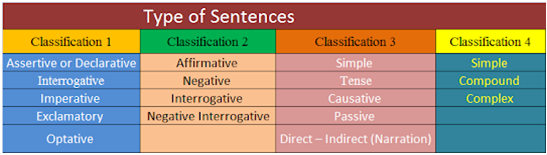
📚 4 Classifications of Sentences (वाक्यों का वर्गीकरण)
Priya: Sir, अंग्रेज़ी में वाक्यों को कितने तरीकों से बाँटा जाता है?
Amit Sir: मुख्य रूप से वाक्यों को 4 अलग-अलग वर्गीकरणों (Classifications) में बाँटा जाता है:
Classification 1: Purpose / Function (कार्य के आधार पर वाक्यों के प्रकार)
Amit Sir: हेलो मेरे प्यारे बच्चों! पिछली क्लास में हमने समझा था कि Sentence क्या होता है। आज की क्लास में हम सीखेंगे—Classification 1: Purpose or Function (कार्य के आधार पर वाक्यों का वर्गीकरण)। यानी वाक्य किस उद्देश्य से बोला जा रहा है, उसके आधार पर इसे 5 मुख्य भागों में बाँटा जाता है।
1. Assertive or Declarative Sentence (वर्णनात्मक वाक्य)
Rohan: सर, सबसे पहला प्रकार ‘Assertive Sentence’ क्या होता है?
Amit Sir: रोहन, जब हम किसी साधारण बात, तथ्य (fact), राय या विचार को व्यक्त करते हैं, तो उसे Assertive या Declarative Sentence कहते हैं। यह हमेशा एक Full Stop (.) पर समाप्त होता है।
Priya: Sir, क्या इसके कुछ उदाहरण देख सकते हैं?
Amit Sir: बिल्कुल प्रिया! इन उदाहरणों को देखो:
I am a student. (मैं एक छात्र हूँ।)
The sun rises in the east. (सूरज पूरब से निकलता है।)
👉 Teacher’s Note: यहाँ हम केवल एक जानकारी दे रहे हैं या सच बता रहे हैं, इसलिए ये Declarative Sentences हैं।
2. Interrogative Sentence (प्रश्नवाचक वाक्य)
Rohan: सर! और जब हम किसी से कोई सवाल पूछते हैं?
Amit Sir: बहुत बढ़िया सवाल! जब भी हम किसी से कोई प्रश्न पूछते हैं, तो वह Interrogative Sentence कहलाता है। इसकी सबसे बड़ी पहचान यह है कि यह हमेशा Question Mark (?) पर समाप्त होता है।
Examples:
What is your name? (आपका नाम क्या है?)
Are you coming to school? (क्या आप स्कूल आ रहे हैं?)
3. Imperative Sentence (आज्ञार्थक वाक्य)
Priya: Sir, अगर हमें किसी को आदेश (Command), प्रार्थना (Request) या सलाह (Advice) देनी हो, तो कौन सा वाक्य प्रयोग होगा?
Amit Sir: तब हम Imperative Sentence का उपयोग करते हैं! इसमें अक्सर ‘You’ कर्ता छिपा (understood) रहता है।
Examples:
Close the door. (दरवाजा बंद करो। — Command)
Please help me. (कृपया मेरी मदद करें। — Request)
4. Exclamatory Sentence (विस्मयादिबोधक वाक्य)
Rohan: सर, जब हम बहुत खुश होते हैं या अचानक हैरान हो जाते हैं, तब?
Amit Sir: शाबाश रोहन! जब हमारे दिल से अचानक कोई तीव्र भाव या भावना (strong feeling/emotion) निकलती है—जैसे खुशी, दुख या आश्चर्य—तो उसे Exclamatory Sentence कहते हैं। यह वाक्य Exclamation Mark (!) पर समाप्त होता है।
Examples:
What a beautiful house! (कितना सुंदर घर है!)
Hurray! We won the match. (हुर्रे! हमने मैच जीत लिया।)
5. Optative Sentence (इच्छार्थक वाक्य)
Priya: Sir, और जब हम किसी के लिए प्रार्थना करते हैं या कोई इच्छा व्यक्त करते हैं?
Amit Sir: प्रिया, जब हम किसी के लिए कोई इच्छा (wish), उम्मीद (hope), प्रार्थना या आशीर्वाद (blessing) व्यक्त करते हैं, तो उसे Optative Sentence कहते हैं। यह अक्सर May या If only से शुरू होता है।
Examples:
May God bless you! (भगवान आपको आशीर्वाद दें!)
If only I could fly! (काश मैं उड़ सकता!)
📊 Summary Table for Quick Revision
| Type of Sentence | Purpose (उद्देश्य) | Ending Punctuation | Master Example |
| 1. Assertive / Declarative | तथ्य या जानकारी देना | Full Stop (.) | I am a student. |
| 2. Interrogative | प्रश्न पूछना | Question Mark (?) | What is your name? |
| 3. Imperative | आदेश, निवेदन या सलाह देना | Full Stop (.) / (!) | Close the door. |
| 4. Exclamatory | अचानक तीव्र भाव व्यक्त करना | Exclamation Mark (!) | What a beautiful house! |
| 5. Optative | इच्छा, प्रार्थना या आशीर्वाद देना | Exclamation / Full Stop | May God bless you! |
Classification 2: Sentences Based on Meaning & Nature (प्रकृति के आधार पर)
Amit Sir: हेलो मेरे प्यारे बच्चों! आज की क्लास में हम वाक्यों का दूसरा वर्गीकरण पढ़ेंगे—Classification 2: Meaning / Nature (प्रकृति या भाव के आधार पर वाक्यों के प्रकार)।
Priya: सर! पहले वर्गीकरण में हमने देखा था कि वाक्य का मुख्य कार्य या उद्देश्य क्या है (जैसे जानकारी देना, प्रश्न पूछना, या आदेश देना)। इस दूसरे वर्गीकरण में हम क्या सीखेंगे?
Amit Sir: बहुत अच्छा सवाल, प्रिया! इस वर्गीकरण में हम यह देखते हैं कि कोई वाक्य अपनी प्रकृति में सकारात्मक (Positive) है, नकारात्मक (Negative) है, या प्रश्न पूछ रहा है (Questioning)। इसके अंतर्गत मुख्य रूप से 4 प्रकार के वाक्य आते हैं।
आइए एक ही क्रिया (She is reading a book) को लेकर इन चारों प्रकारों को समझते हैं:
1. Affirmative Sentences (सकारात्मक वाक्य)
Amit Sir: पहला प्रकार है Affirmative Sentence। यह किसी बात या स्थिति को सकारात्मक रूप से स्वीकार करता है कि कोई कार्य हो रहा है या सच है।
Definition: An affirmative sentence states a positive fact or action.
Structure: Subject + Auxiliary Verb + Main Verb + Object
Example:
English: She is reading a book.
Hindi: वह एक किताब पढ़ रही है।
Rohan: यानी सर, इसमें कोई इंकार या सवाल नहीं होता, यह एक सीधा सकारात्मक कथन होता है?
Amit Sir: बिल्कुल सही, रोहन!
2. Negative Sentences (नकारात्मक वाक्य)
Amit Sir: जब हमें किसी बात को नकारना हो या यह बताना हो कि कोई कार्य नहीं हो रहा है, तो हम Negative Sentence का प्रयोग करते हैं।
Definition: A negative sentence expresses that something is not happening or is false.
Structure: Subject + Auxiliary Verb + NOT + Main Verb + Object
Grammar Rule: इसमें हेल्पिंग वर्ब के तुरंत बाद not का प्रयोग किया जाता है।
Example:
English: She is not reading a book.
Hindi: वह किताब नहीं पढ़ रही है।
3. Interrogative Sentences (प्रश्नवाचक वाक्य)
Priya: सर, अगर हमें यही बात सवाल के रूप में पूछनी हो तो?
Amit Sir: तब हम Interrogative Sentence का उपयोग करेंगे! जब हम किसी स्थिति या कार्य के बारे में जानकारी लेने के लिए प्रश्न पूछते हैं, तो हेल्पिंग वर्ब कर्ता (Subject) से पहले आ जाती है।
Definition: An interrogative sentence is used to ask a question.
Structure: Auxiliary Verb + Subject + Main Verb + Object?
Example:
English: Is she reading a book?
Hindi: क्या वह किताब पढ़ रही है?
4. Negative Interrogative Sentences (नकारात्मक प्रश्नवाचक वाक्य)
Amit Sir: चौथा और सबसे दिलचस्प प्रकार है Negative Interrogative Sentence। इसमें प्रश्न और नकारात्मकता (Not) दोनों एक साथ जुड़े होते हैं। इसका प्रयोग प्रायः आश्चर्य, शंका या पुष्टि (Confirmation) पाने के लिए किया जाता है।
Definition: A negative interrogative sentence asks a question in a negative form.
Structure: Auxiliary Verb + NOT + Subject + Main Verb + Object? (या Contraction रूप: Isn’t / Aren’t + Subject…)
Example:
English: Isn’t she reading a book?
Hindi: क्या वह किताब नहीं पढ़ रही है?
📊 Summary Comparison Table (त्वरित तुलनात्मक सारणी)
Amit Sir: एग्ज़ाम से पहले तुरंत रिवीज़न के लिए इस चार्ट को ध्यान से देखो:
| Sentence Type | Structure Formula | English Example | Hindi Translation |
| 1. Affirmative | Sub + Aux + Main Verb + Obj | She is reading a book. | वह एक किताब पढ़ रही है। |
| 2. Negative | Sub + Aux + NOT + Main Verb + Obj | She is not reading a book. | वह किताब नहीं पढ़ रही है। |
| 3. Interrogative | Aux + Sub + Main Verb + Obj? | Is she reading a book? | क्या वह किताब पढ़ रही है? |
| 4. Negative Interrogative | Aux + NOT + Sub + Main Verb + Obj? | Isn’t she reading a book? | क्या वह किताब नहीं पढ़ रही है? |
📚 Classification 3: Advanced Usage / Context (विशेष प्रयोग के आधार पर)
Amit Sir: हेलो बच्चों! अभी तक हमने वाक्यों के बुनियादी प्रकार सीखे। अब हम सीखेंगे Classification 3, यानी विशेष प्रयोग और संदर्भ (Context) के आधार पर वाक्यों को किन-किन भागों में बाँटा जाता है। यह भाग आपकी एडवांस्ड इंग्लिश और कंपैटिटिव एग्जाम्स के लिए बहुत महत्वपूर्ण है!
Priya: Sir, विशेष प्रयोग का मतलब क्या होता है? क्या वाक्य का अर्थ और ढाँचा परिस्थिति के हिसाब से बदल जाता है?
Amit Sir: बिल्कुल सही पकड़ा प्रिया! आइए इसे 5 मुख्य भागों में बाँटकर आसान बातचीत के ज़रिए समझते हैं:
1. Simple / General Sentences (सामान्य वाक्य)
Amit Sir: सबसे पहले आते हैं साधारण वाक्य। ये वे वाक्य होते हैं जो केवल एक मुख्य विचार (Single Complete Thought) को व्यक्त करते हैं।
Example:
I study English every day. (मैं रोज़ अंग्रेज़ी पढ़ता हूँ।)
2. Tense Sentences (कालवाचक वाक्य)
Rohan: Sir, क्या जो वाक्य हम टेंस में समय दिखाने के लिए बनाते हैं, वे अलग श्रेणी में आते हैं?
Amit Sir: बिल्कुल रोहन! ये वे वाक्य हैं जो क्रिया के रूप (Verb Forms) से किसी कार्य के समय यानी Present (वर्तमान), Past (भूतकाल), और Future (भविष्यकाल) को दर्शाते हैं।
Examples:
I play cricket every day. (वर्तमानकाल – Present Tense)
He woke up early yesterday. (भूतकाल – Past Tense)
3. Causative Sentences (प्रेरणार्थक वाक्य)
Priya: Sir, जब हम कोई काम खुद न करके किसी और से करवाते हैं, तो उसे अंग्रेज़ी में कैसे बोलते हैं?
Amit Sir: बहुत ही बेहतरीन सवाल प्रिया! ऐसे वाक्यों को हम Causative Sentences कहते हैं। इनमें कर्ता (Subject) स्वयं काम नहीं करता, बल्कि किसी अन्य व्यक्ति को प्रेरित करता है या उससे काम करवाता है। इसके लिए हम मुख्य रूप से make, let, have, और get का प्रयोग करते हैं।
Examples:
She got her car washed. (उसने अपनी कार धुलवाई—खुद नहीं धोई!)
I am having my house painted. (मैं अपना घर पेंट करवा रहा हूँ।)
4. Passive Voice (कर्मवाच्य वाक्य)
Rohan: Sir, और जब हमारा मुख्य ध्यान काम करने वाले पर न होकर, उस काम या वस्तु पर हो?
Amit Sir: तब हम Passive Voice का प्रयोग करते हैं! इसमें कर्ता (Subject) की जगह कर्म (Object) पर ध्यान केंद्रित होता है, यानी क्रिया का प्रभाव किस पर पड़ रहा है, वह मुख्य बन जाता है।
Example:
Active: Ram writes a letter. (राम एक पत्र लिखता है—यहाँ ‘राम’ मुख्य है।)
Passive: A letter is written by Ram. (एक पत्र राम द्वारा लिखा जाता है—यहाँ ‘पत्र’ मुख्य है।)
5. Direct – Indirect Narration (कथन वाक्य)
Priya: Sir, जब हम किसी की कही हुई बात को किसी तीसरे व्यक्ति को बताते हैं, तो उसे क्या कहते हैं?
Amit Sir: उसे हम Narration (कथन) कहते हैं, जो दो प्रकार के होते हैं:
Direct Speech: जब हम वक्ता (Speaker) के सटीक शब्दों को ज्यों का त्यों (Inverted Commas में) दोहराते हैं।
He said, “I am tired.” (उसने कहा, “मैं थका हुआ हूँ।”)
Indirect Speech: जब हम वक्ता के भाव को अपने शब्दों में व्यक्त करते हैं।
He said that he was tired. (उसने कहा कि वह थका हुआ था।)
📊 Summary Table for Quick Revision
| प्रकार (Type) | मुख्य पहचान / कार्य | Example (उदाहरण) |
| 1. Simple Sentences | एक ही स्वतंत्र विचार | I study English every day. |
| 2. Tense Sentences | Verb Forms से समय दर्शाना | He woke up early yesterday. |
| 3. Causative Sentences | दूसरों से काम करवाना (make, get, have) | She got her car washed. |
| 4. Passive Voice | Object (कर्म) पर मुख्य ध्यान | A letter is written by Ram. |
| 5. Direct-Indirect | किसी के कहे कथन को प्रस्तुत करना | He said that he was tired. |
Classification 4: Clause Structure (संरचना के आधार पर वाक्यों का वर्गीकरण)
Rohan: Sir, क्लॉज़ (Clause) के हिसाब से वाक्य कितने प्रकार के होते हैं?
Amit Sir: रोहन, यह बोर्ड और प्रतियोगी परीक्षाओं (Competitive Exams) के लिए पूरे ग्रामर का सबसे महत्वपूर्ण और स्कोरिंग भाग है! क्लॉज़ (Clause) यानी उपवाक्य की संरचना के आधार पर वाक्य 3 मुख्य प्रकार के होते हैं:
1. Simple Sentence (साधारण वाक्य)
Amit Sir: बच्चों, Simple Sentence वह वाक्य होता है जिसमें केवल एक Independent Clause (स्वतंत्र उपवाक्य) होता है। इसका मतलब है कि इसमें एक मुख्य कर्ता (Subject) और एक क्रिया (Predicate) होती है जो अपना पूरा अर्थ अकेले व्यक्त कर सकती है।
Structure Formula:
$$\text{Subject} + \text{Verb} + \text{Object/Complement} \quad (\text{Single Complete Thought})$$Example:
👉 I like reading books.
(हिंदी अनुवाद: मुझे किताबें पढ़ना पसंद है।)
Priya: Sir, इसमें कोई दूसरा क्लॉज़ या कंजंक्शन जुड़ सकता है?
Amit Sir: नहीं प्रिया! इसमें केवल एक ही क्लॉज़ होगा, जो अपने आप में पूरा अर्थ देगा।
2. Compound Sentence (संयुक्त वाक्य)
Amit Sir: Compound Sentence वह वाक्य है जिसमें दो या दो से अधिक Independent Clauses (स्वतंत्र विचार) होते हैं। ये दोनों वाक्य अपने आप में पूरे होते हैं और इन्हें आपस में Coordinating Conjunctions से जोड़ा जाता है।
💡 Master Trick (FANBOYS):
Coordinating Conjunctions को याद रखने के लिए FANBOYS शब्द याद रखें:
For, And, Nor, But, Or, Yet, So.
Examples:
I wanted to go for a walk, but it started raining.
(हिंदी अनुवाद: मैं टहलने जाना चाहता था, लेकिन बारिश शुरू हो गई।)
👉 Logic: “I wanted to go for a walk” और “it started raining” दोनों स्वतंत्र वाक्य हैं जिन्हें ‘but’ से जोड़ा गया है।
He was tired, so he went to bed early.
(हिंदी अनुवाद: वह थका हुआ था, इसलिए वह जल्दी सोने चला गया।)
👉 Logic: यहाँ दो स्वतंत्र वाक्यों को ‘so’ से जोड़ा गया है।
3. Complex Sentence (जटिल वाक्य)
Rohan: Sir, फिर Complex Sentence में क्या अलग होता है?
Amit Sir: बहुत अच्छा सवाल रोहन! Complex Sentence में एक Independent Clause (मुख्य विचार) और कम से कम एक Dependent / Subordinate Clause (आश्रित विचार) होता है। Dependent Clause का अपना पूरा अर्थ नहीं होता; वह अर्थ पूरा करने के लिए मुख्य क्लॉज़ पर निर्भर रहता है।
इन्हें आपस में Subordinating Conjunctions (जैसे—because, although, if, when, since, while, after, before) से जोड़ा जाता है।
Examples:
When I finished my homework, I went to sleep.
(हिंदी अनुवाद: जब मैंने अपना होमवर्क पूरा कर लिया, तब मैं सोने चला गया।)
👉 Logic: “When I finished my homework” एक Dependent Clause है (अगर सिर्फ इतना कहें “जब मैंने होमवर्क पूरा किया”, तो बात अधूरी लगती है)। इसका अर्थ “I went to sleep” (Independent Clause) से जुड़कर ही पूरा होता है।
Because it was raining, we stayed at home.
(हिंदी अनुवाद: क्योंकि बारिश हो रही थी, इसलिए हम घर पर रहे।)
👉 Logic: “Because it was raining” आश्रित क्लॉज़ है और “we stayed at home” मुख्य स्वतंत्र वाक्य है।
🎯 Quick Comparison Table for Exams
| Sentence Type | Structure (संरचना) | Joining Words (कंजंक्शन) | Main Feature (मुख्य पहचान) |
| Simple | 1 Independent Clause | None | केवल 1 स्वतंत्र विचार |
| Compound | 2+ Independent Clauses | FANBOYS (and, but, or, so…) | दोनों विचार बराबर और स्वतंत्र |
| Complex | 1 Independent + 1+ Dependent | because, although, if, when… | 1 मुख्य और 1 उस पर आश्रित विचार |
🎓 Teacher’s Summary Table
| Classification Type | Sub-Categories | Core Purpose / Key Feature |
| Classification 1 | Assertive, Interrogative, Imperative, Exclamatory, Optative | वाक्य के उद्देश्य और अभिव्यक्ति के आधार पर |
| Classification 2 | Affirmative, Negative, Interrogative, Negative Interrogative | वाक्य की सकारात्मकता या नकारात्मकता के आधार पर |
| Classification 3 | Simple, Tense, Causative, Passive, Direct-Indirect | व्याकरणिक प्रयोग और संदर्भ के आधार पर |
| Classification 4 | Simple, Compound, Complex | Clauses (वाक्यांशों) की संरचना के आधार पर |
Conclusion (निष्कर्ष)
दोस्तों, आज की क्लास में हमने विस्तार से सीखा कि Sentence क्या होता है, इसके मुख्य भाग कौन-कौन से हैं और किस तरह वाक्य को 4 अलग-अलग वर्गीकरणों में विभाजित किया जाता है। इन बुनियादी नियमों को समझकर आप अपनी इंग्लिश राइटिंग और स्पीकिंग दोनों को बेहद मजबूत बना सकते हैं।
व्याकरण के ऐसे ही गहराई से भरे पाठ पढ़ने के लिए ब्लॉग को अपने दोस्तों के साथ शेयर करना न भूलें!